




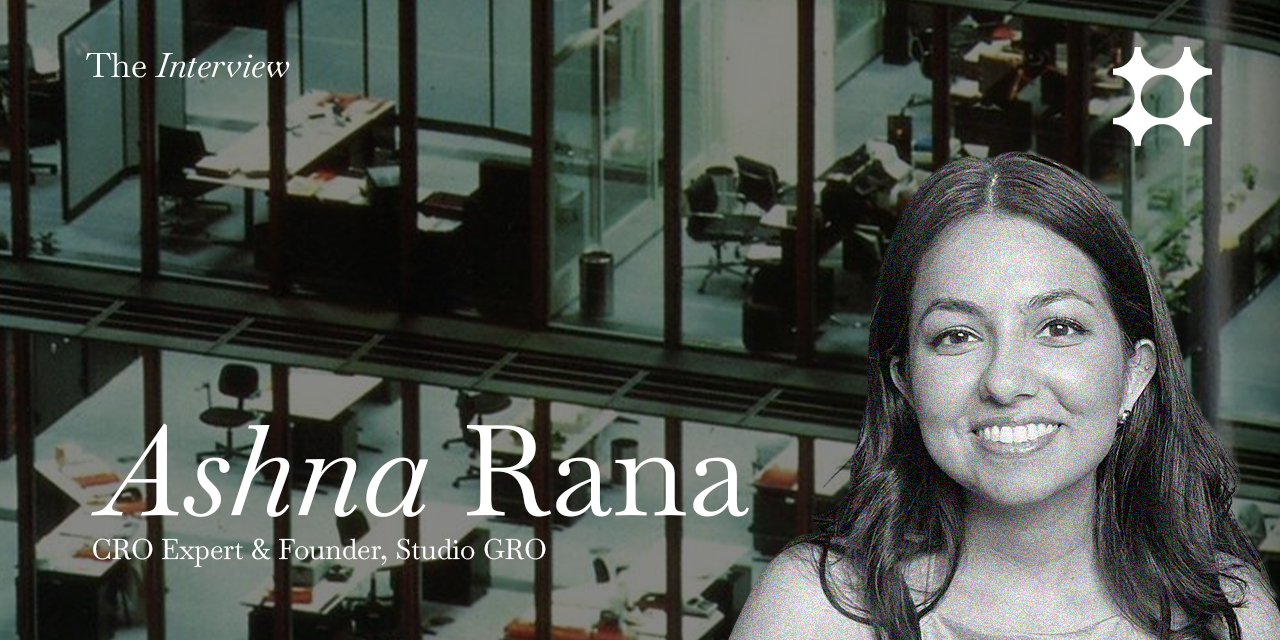
Ashna Rana runs a boutique CRO studio, Studio Gro, specializing in experimentation programs for health and wellness CPG brands. She's worked with brands from pre-revenue to $50M, including Casper, Ritual, Manukora and Kolkata Chai, driving measurable CVR improvements of 30%+ for clients." We sat down with Ashna to get the insights:
When to focus on CRO
You’ve worked with brands like Casper and Ritual: At what point does CRO start to matter? Is it something early-stage brands should care about, or is it a $3M+ revenue practice?
Any growing business needs to care about improving CVR, AOV and CPA. It requires increasing the number of shots you take—volume, decreasing the time between those shots—velocity and improving the accuracy of those shots—precision. A brand can pursue all three at $50K and at $50M, but how those three metrics are met vary as a business grows.
Given your experience, what are the first three things you tend to notice on a site that tells you whether the brand is converting or not?
1. Whether the brand is running paid traffic to landing pages.
2. How clearly the value proposition is communicated on the homepage hero as well as the top of fold on the product detail page.
3. How easy it is to differentiate between products by use or function, specifically with navigation and PLP.
At the highest level CRO requires analyst style thinking and even data scientists. How has AI changed that, and what can founders now do that they couldn’t two years ago?
AI is fundamentally increasing the speed and clarity with which founders can understand where their product/brand is excelling or falling short. This stems from the fact that AI has made it easy to parse through enormous amounts of data and reach clear conclusions at remarkable speed. Including user surveys, post purchase surveys, competitor analysis, and actual test data analysis to identify trends.
I use it the way I'd use a smart team member: to pressure-test a point of view, sharpen a message, or think through a problem from a different angle. That's meaningful. But handing a founder an AI audit of their site without the strategic foundation to interpret it isn't an upgrade. A tool without the knowledge to use it for your specific purpose is a net nothing.
Can you give an example of a situation where margin or conversion was being lost and the data proved a different direction in solution to what was expected?
One of my clients is a premium home furnishings brand with over 100 products. We notice that desktop users have a much higher intent and conversion rate than mobile users that were learning about the brand for the first time.
With that starting data point, we started navigation specific tests to improve and differentiate between the desktop and mobile flow experience. We noticed that increasing the visibility of specific high AOV category tanked CVR in mobile but increased CVR and RPV in desktop. This singular data point has continued to shape the direction of how the desktop and mobile experience evolves, along with the offers we run for paid media vs. their organic traffic.
There is a theory with AI that websites could become self-optimizing, what happens to CRO as a discipline? Does it disappear or evolve?
Self-optimizing websites exist and are built on multi-armed bandit testing methodologies—this is not a new concept, but one that has existed for years. With time and increased technology, the ability to create multi-armed bandit tests has only become easier, but that doesn't mean CRO itself will disappear.
Experimentation has always had a clear workflow that requires development. The cost, financially and time-wise, may decrease as AI-generated, self-optimizing tests become more accessible, but the decision of what we test and the inputs into those tools will still remain. For example, tests can sometimes increase CVR while decreasing AOV and RPV. A result like this could have a meaningfully negative impact on the growth of a business depending on its margins—and no tool can make that call without being explicitly given the context to do so.
I believe the discipline of experimentation—deciding what we test, how we measure it, and how we disperse findings across channels—will not become obsolete. Experimentation strategy survives because it requires business context, customer psychology, and prioritization trade-offs that no tool has access to without being explicitly fed them.
The thinking around CRO can be very granular, questions are linked to data, but there is a bigger picture. What are some of your viewpoints around emotion and behaviour around purchases?
You are marketing to people on the other side of the screen. Reducing them to pixels and data points minimizes the human element of a digital marketplace—and that's a mistake. You need to be asking the question: Why should someone care about why their paycheck goes to your project?
You need to be asking the question: Why should someone care about why their paycheck goes to your project?
People are growing up online rather than coming to it later in life. With that, dark pattern recognition has only increased. Early CRO was built heavily on dark pattern methods: false urgency, manufactured scarcity, manipulative defaults. I believe brands that rely on exploiting human emotion to convert will not scale and will not last—especially as the demographic makeup of the American consumer continues to evolve. That is not the future of CRO.
If you had a magic CRO wand, what’s one thing you’d fix on 80% of e-commerce websites today?
Optimize the first two folds of their homepage to explain their product as clearly as possible. A new user should know what you do and what makes you unique within one to two scrolls.
In our rapidly changing world and e-commerce landscape in 2026 what would your biggest focuses be on over the next six to twelve months.
I would focus on:
1. Re-testing any offers the company has been using for some time, thinking it’s a homerun offer. Measure the profitability, LTV, APV and CVR of that offer intensively across channels
2. Re-analyzing any copycats, and competitors in your space. Ensure your website content, positioning and value is clear and trustworthy in relation to those competitors to protect your company from having to compete on price. Competing on price is a race to the bottom.